AC vs DC EV Charging for Fleets: Which Does Your Operation Actually Need?
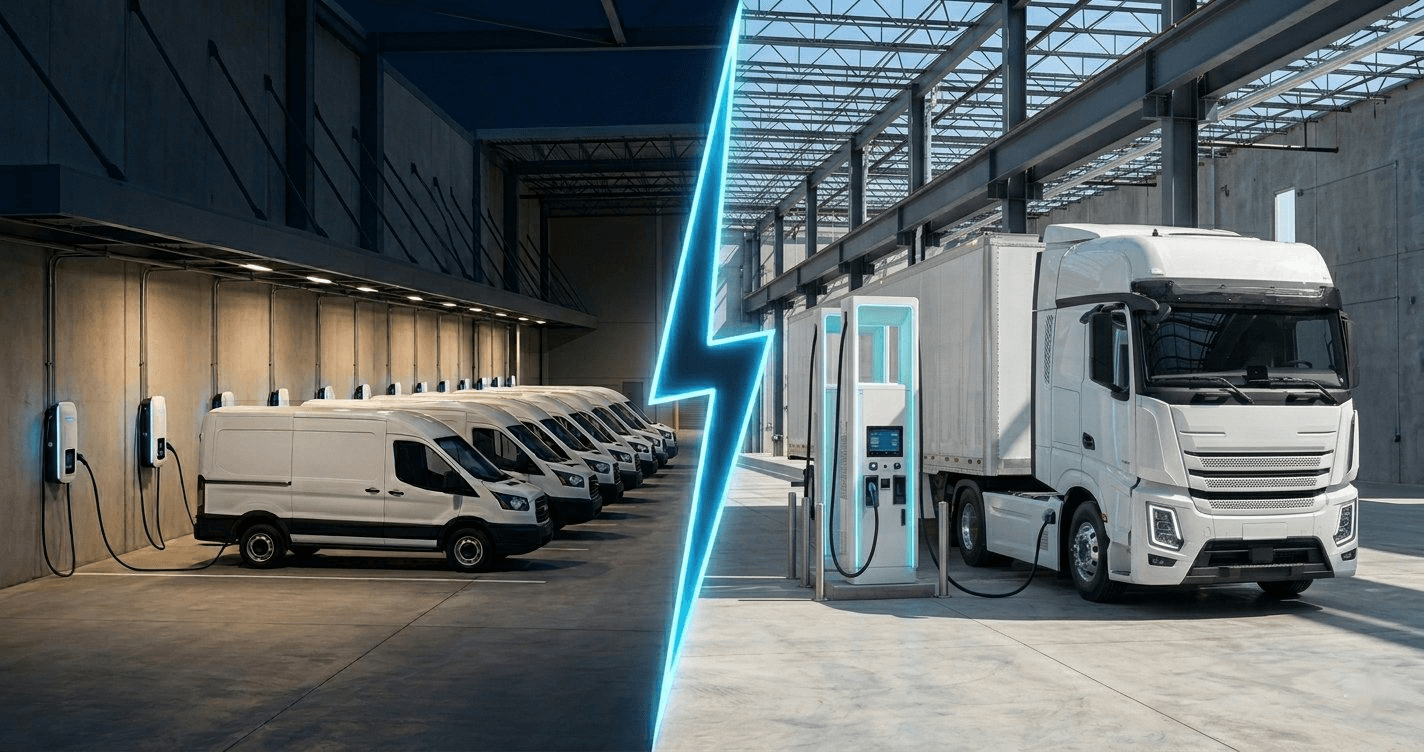
Most fleet operators reach the same question once electrification becomes a line on the budget: AC chargers, DC fast chargers, or both? Two things settle it — what the actual difference between them is, and why charger type matters for how your fleet runs.
This guide covers both, plus why "faster" isn't automatically "better" and how to match the right mix to depot, workplace and en-route charging in South Africa.
The real difference: where the conversion happens
Every battery stores and uses direct current (DC). The electricity grid delivers alternating current (AC). So somewhere between the wall and the battery, AC has to be converted to DC. That single fact is the whole distinction between the two charging types.
With AC charging, the conversion from AC to DC happens inside the vehicle, using its onboard charger and rectifier. The charger on the wall is essentially a smart, safe supply of AC power, and the vehicle decides how fast it can accept it. That means an AC charger's real-world speed is capped by the vehicle's onboard charger — not by the unit on the wall.
With DC charging, the conversion happens inside the charger itself. A DC fast charger is a much larger, more powerful piece of equipment that converts AC to DC on the spot and feeds DC straight into the battery, bypassing the onboard charger's limit. That's why DC chargers can deliver far more power, and why they cost considerably more.
Understanding this one point makes every other trade-off — speed, cost, grid impact — fall into place.
AC charging: built for dwell time
AC chargers for commercial use typically run from around 7 kW (single-phase) up to 22 kW (three-phase). At those power levels, a full charge takes several hours — which sounds like a drawback until you look at how most fleet vehicles actually spend their day.
A delivery van, a sales pool car, a municipal vehicle — these sit idle far longer than they drive. They return to a depot or workplace and park overnight for eight, ten, twelve hours. AC charging is designed precisely for that window. You're not trying to charge fast; you're trying to charge cheaply and reliably while the vehicle is doing nothing anyway.
AC is also the workhorse of depot and workplace charging because it's cheaper per unit, gentler on the grid, and easy to scale across many bays. Twenty AC chargers drawing modest power, managed intelligently, are far simpler to connect and run than twenty DC units. For most depot-based fleets, AC handles the overwhelming majority of energy delivered.
DC fast charging: built for time pressure
DC fast chargers start around 30 kW and climb to 400 kW and beyond. They exist for one reason: to put a lot of energy into a battery quickly, when there isn't time to wait.
That makes DC the right tool for en-route and opportunity charging — a vehicle topping up mid-route, a shared asset that can't afford downtime, or a long-haul truck that needs to add range during a driver's break. It's also often essential for heavy vehicles simply because their batteries are so large that AC charging would take impractically long, even overnight.
The catch is that DC's power comes with real consequences. The hardware is expensive. The grid connection is demanding — a bank of fast DC chargers can require a dedicated supply, a transformer upgrade, or a solar and battery system to manage demand, and high power draw, if not done right, can trigger demand charges on your electricity tariff that quietly inflate running costs. DC is powerful, but it is never the cheap option, and over-specifying it is one of the most common and costly mistakes in fleet charging.
Used in the right place, though, DC fast charging more than earns its premium: it keeps vehicles working instead of waiting, and the extra utilisation — and the diesel it displaces — stacks up savings that offset the cost of the charger.
AC vs DC at a glance
| AC charging | DC fast charging | |
|---|---|---|
| Where AC→DC conversion happens | Onboard the vehicle | Inside the charger (off-board) |
| Typical power | 7–22 kW | 30–400 kW+ |
| Connector (SA) | Type 2 | CCS2 |
| Time for a meaningful charge* | 6–10+ hours | 20–90 minutes |
| Best suited to | Overnight depot, workplace, long dwell | En-route top-ups, short dwell, heavy vehicles |
| Hardware cost | Lower | Higher |
*Real charging time depends on battery size and, for AC, the vehicle's onboard charger limit.
Charging speeds, explained honestly
The headline kW figure on a charger tells you its maximum output, not what your vehicle will actually receive. Two things complicate the simple "bigger number = faster" assumption.
First, the vehicle sets the ceiling — and it has two of them. Every EV has a separate limit for AC and for DC charging. Its AC limit is set by the onboard charger: plug a van with a 7.4 kW onboard charger into a 22 kW AC unit and it still charges at 7.4 kW — the extra capacity does nothing for that vehicle. Its DC limit is a different, usually much higher figure, because DC bypasses the onboard charger entirely. So a vehicle might cap at 7.4 kW on AC but cap at 120 kW on DC. Matching charger output to what each vehicle can actually accept — on each type — is how you avoid paying for charger speed you'll never use.
Second, DC charging tapers. A battery accepts its fastest charge when it's relatively empty; as it fills past roughly 80%, the rate drops sharply to protect the cells. This is why DC speeds are quoted as "20–80% in X minutes" rather than 0–100%. For fleet planning, the practical takeaway is to think in terms of the energy you need added during the available window, not a full charge every time.
A useful rough estimate: charging time in hours ≈ energy needed (kWh) ÷ charger power (kW). It's only an approximation — efficiency losses and the DC taper make it optimistic at the top end — but it's enough to sanity-check whether a charging strategy fits your operating day.
Which does your fleet need?
The honest answer for most operations is both, in the right proportion. But you can reason your way to the right mix by asking three questions.
How long do vehicles sit still? If they dwell for hours — overnight at a depot, all day at a workplace — AC is almost certainly your primary solution. Long dwell time is the single strongest signal that you don't need to pay for DC.
Do vehicles need to charge during operating hours? If a vehicle has to top up mid-shift to complete its routes, or if downtime directly costs you money, that's where DC earns its premium. The question isn't whether DC is faster — it's whether the speed is worth the cost for that specific use case.
How big are the batteries? Light vehicles charge comfortably on AC overnight. Electric trucks and large vehicles, with much bigger packs, may need DC even at the depot simply to be ready by morning. Vehicle type quietly drives a lot of the decision.
Run those three questions across your fleet and a pattern usually emerges: a backbone of AC chargers for overnight depot and workplace charging, with a smaller number of DC units placed where time pressure genuinely justifies them. Most well-designed fleet charging looks like this — AC for the routine, DC for the exceptions.
If you're weighing up the commercial EV chargers themselves, the same logic applies whether you're charging electric vans on overnight AC or topping up electric trucks on DC between shifts.
Getting the mix right without overspending
The reason this matters financially is simple: AC is cheap and DC is expensive. Specify too little DC and vehicles aren't ready when you need them. Specify too much and you've spent money on power your fleet never draws, while signing up for demand charges you didn't need to.
Getting that balance right isn't guesswork. It comes from understanding the vehicles and your real duty cycles — how far vehicles travel, how long they dwell, and how much energy they actually consume between charges. That's the work a proper site survey does: model the fleet's energy demand, size the right blend of AC and DC, and design the electrical infrastructure and load management to support it without overloading your grid connection.
If you'd like that modelled for your operation, get in touch for a consultation.
Frequently asked questions
What's the main difference between AC and DC charging?
With AC charging, the vehicle's onboard charger converts AC from the grid into the DC the battery needs, which caps the speed. With DC charging, the charger does the conversion and feeds DC straight to the battery, allowing much higher power. AC converts inside the vehicle; DC converts inside the charger.
Is DC charging always faster?
DC delivers far more power, so it charges faster, but the gain is limited by what the vehicle can accept and by the natural slowdown as the battery fills past about 80%. For vehicles that sit for hours, that extra speed often isn't worth the added cost.
Which charger does my fleet need?
It depends on dwell time, whether vehicles must charge during operating hours, and battery size. Fleets that park overnight usually rely on AC; those needing mid-shift top-ups or running heavy vehicles add DC where justified. Most operations use a mix.
Can I charge an electric truck on an AC charger?
Technically yes, but a truck's large battery may take impractically long on AC alone. Heavy vehicles often need DC charging to be ready within an operating window, even at the depot.
Does DC fast charging wear out the battery faster?
Modern EV batteries are designed to handle DC fast charging, with thermal management to protect the cells. Occasional fast charging has minimal impact; relying on it exclusively every cycle accelerates wear more than a balanced approach that uses AC for routine charging.
Do I need both AC and DC at my depot?
Frequently, yes. A common, cost-effective setup is a backbone of AC chargers for overnight charging plus a smaller number of DC units for vehicles that need rapid turnaround. The right ratio comes from your fleet's actual duty cycles.
Ready to electrify your fleet?
Talk to the Flux Fleet team about what switching to electric looks like for your operation.
Get in touch