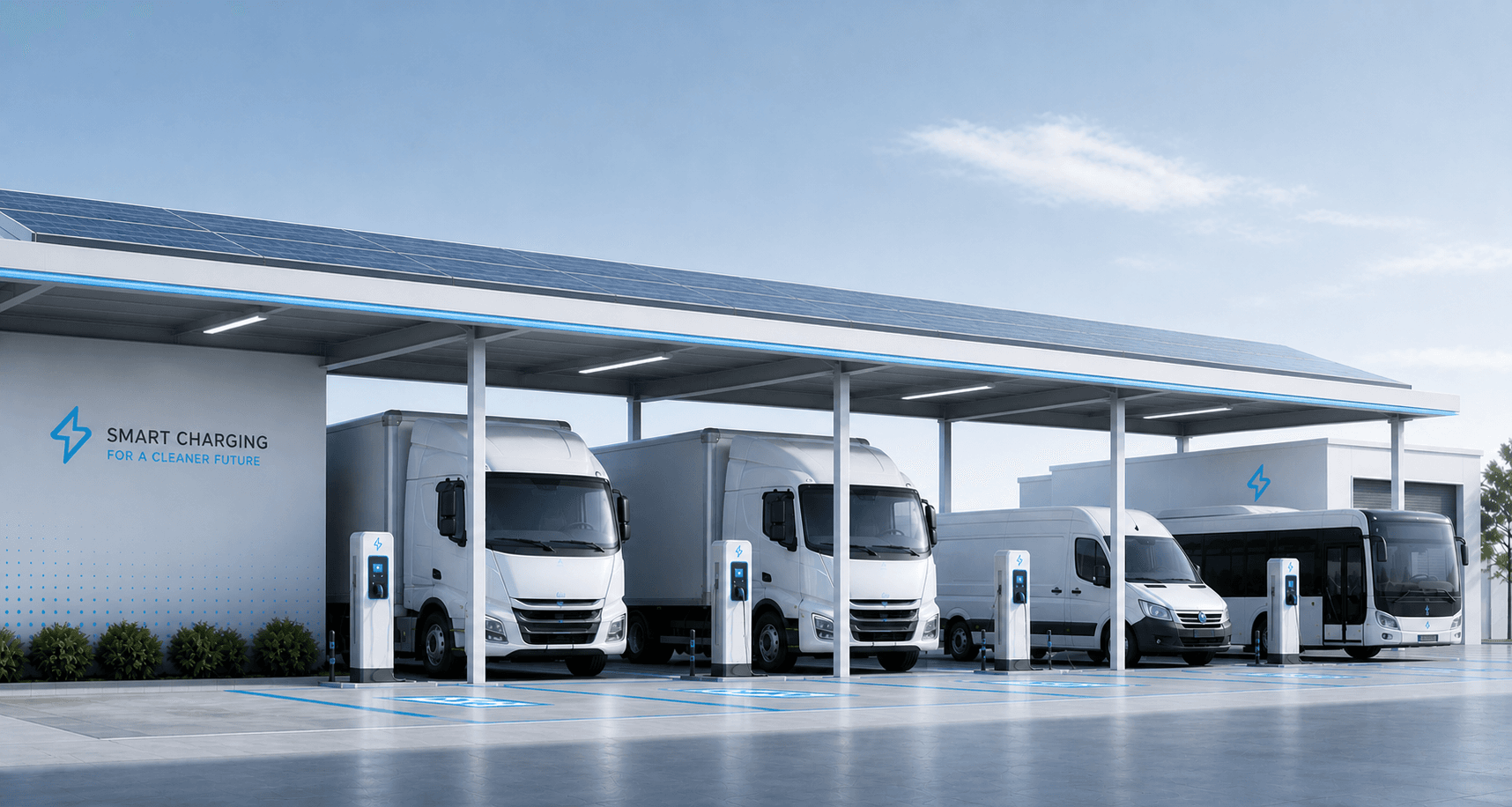
Fleet charging solutions
EV charging infrastructure built around your fleet
A fleet is not a single vehicle — it is a network of routes, dwell times, and energy demands. Getting the EV charging infrastructure right from the start is what keeps every vehicle productive and every driver on the go.
Depot charging
Vehicles return to base overnight and plug in. A mix of AC chargers across the depot lets every vehicle start the day fully charged at off-peak electricity rates — the lowest-cost model for most fleets.
En-route top-ups
Multi-shift or long-haul operations need DC fast charging for midday top-ups. We investigate opportunities for en-route DC fast chargers and spec the charging solution so vehicles can complete their routes without constraint.
Power upscaling
If your site lacks the grid capacity for charging, or you want to reduce your electricity cost further, we integrate solar generation and battery storage — supplementing the grid where needed or offsetting peak tariffs entirely.
Scaling a fleet charging network across a large depot means planning for grid capacity, load management, and room to grow. South African fleet operators face additional considerations — power availability, load-shedding resilience, and available transformer headroom. We conduct a full site survey and grid assessment before any hardware is specified, so the EV charging stations we install match your energy reality, not just a catalogue spec.
From a single 7 kW AC charger for a small last-mile fleet, to a 400 kW+ DC fast charging hub serving dozens of commercial EV chargers across a national depot network — Flux Fleet sizes, installs, and manages the solution end to end. Fleet EV charging in South Africa does not have a to be difficult. When done right, it is easier than diesel fueling - and a lot more cost effective.
AC and DC fast chargers
The right charger depends on your vehicles, routes and how long they sit between shifts. We size every solution to match your requirement. Not sure which you need? Read our AC vs DC charging guide.
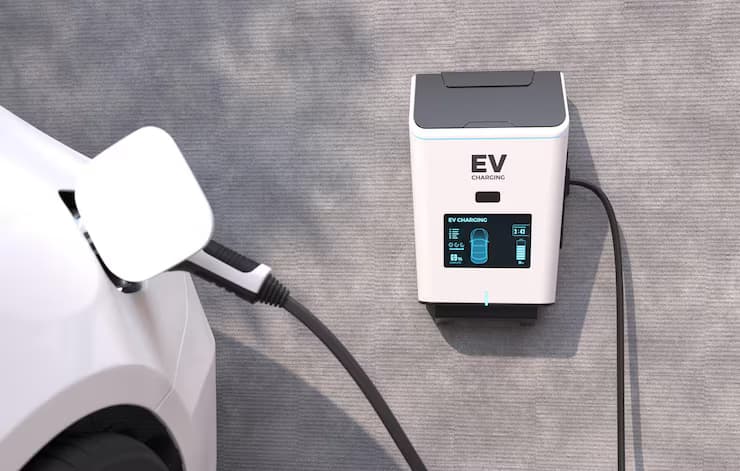
AC chargers
Cost-effective overnight charging for fleets that return to base each day.
Specs
- 7 kW – 22 kW output
- 6–8 hours for a full charge
- Single-phase or three-phase
- Optimised overnight charging at off-peak electricity rates
Best for
- Last-mile delivery vans
- Light commercial fleets
- Depot and overnight workplace charging

DC fast chargers
High-power charging for trucks, high-utilisation vehicles, or 24/7 operations.
Specs
- 30 kW – 400 kW output
- 30–60 min to 80% charge
- CCS2 connectors
- Dynamic load balancing
Best for
- Multi-shift fleets needing midday top-ups
- Heavy trucks
- Customer destination and depot charging
- 24-hour operations
Chargers for sale

Commercial AC EV Charger
- 7, 11 & 22 kW variants
- Single- & three-phase
- Type 2 tethered · OCPP 1.6J
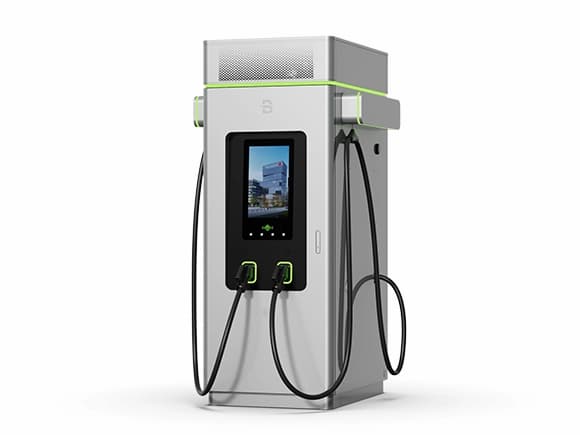
DC Fast Charger
- 30 kW – 400 kW output
- CCS2 connector
- 30–60 min to 80% charge
An alternative to buying
Charging-as-a-Service: chargers without the capital cost
We install, own, operate and maintain the charging infrastructure. You pay a predictable monthly fee that scales with your fleet — no upfront capital expense, no maintenance overhead, no obsolescence risk.
Optional solar and battery storage can be included so power availability is never an issue.
Charging-as-a-Service is subject to eligibility assessment. Approval is determined on a case-by-case basis taking into account site requirements, creditworthiness, and other operational factors.
No upfront capex
Flip charging from a balance-sheet purchase to a predictable operational expense.
Maintenance included
We monitor, service and replace hardware. Uptime is our problem, not yours.
Scale up or down
Add chargers as your fleet grows or relocate hardware when routes change.
What we offer
How it works
Site survey
We assess your depot, energy capacity and vehicle requirements to scope the right solution.
Design
We design the charging and energy infrastructure to ensure energy availability and fleet uptime.
Install & support
Certified installation, full commissioning, and ongoing 24/7 remote monitoring and support.
EV charger questions — answered
How much does a commercial EV charger cost in South Africa?
AC chargers start from around R12,000. DC fast charger pricing is use-case specific — it depends on power output, grid connection requirements, site works, and the optimal mix of chargers for your fleet. We assess your requirements and design the right solution, then quote accordingly.
Request a quote →What is the difference between AC and DC fast chargers?
AC chargers (7–22 kW) are ideal for overnight depot charging for smaller vehicles — vehicles charge slowly while parked, drawing on off-peak electricity rates. DC fast chargers (30–400 kW) deliver rapid top-ups in 30–60 minutes and suit multi-shift fleets, heavy trucks, or any operation where vehicles cannot sit overnight.
How long does it take to charge an electric van or truck?
With AC charging, a full charge typically takes 5–8 hours — which fits neatly into an overnight depot cycle. DC fast charging reaches 80% in 30–60 minutes, making it practical for midday top-ups or between shifts.
What is Charging-as-a-Service (CaaS)?
With our Charging-as-a-Service model, Flux Fleet installs, owns, operates, and maintains the chargers. You pay a predictable monthly fee that scales with your fleet — no upfront capital expense, no maintenance overhead, and no hardware obsolescence risk. Optional solar and battery storage can be included.
Can EV chargers run on solar in South Africa?
Yes. We integrate solar generation and battery storage with your EV charging infrastructure so that load-shedding and grid constraints do not interrupt charging cycles. This also reduces the cost per kWh over time.
Where do you install EV chargers in South Africa?
Nationwide — with project teams and support across Johannesburg, Cape Town, Durban, and Pretoria. We install at depots, warehouses, distribution centres, and workplace sites.
What charger does my fleet need?
It depends on your vehicles, daily routes, and how long they sit between shifts. Our site survey and feasibility process models your exact duty cycle and recommends the right mix of AC and DC chargers. As a starting point, our AC vs DC guide walks through the decision.
Read the AC vs DC guide →How many chargers does my fleet need?
Fleet size, daily energy consumption, and shift patterns all drive the answer. A 20-vehicle depot running a single overnight shift typically needs 10 dual connector AC chargers with smart load management, and 1-2 DC fast chargers if needed. We model this in detail during our site survey, sizing the right mix of AC and DC chargers for your operation.
Ready to charge up your fleet?
Tell us about your fleet — we'll come back with a charger proposal sized to your vehicles, routes and energy availability.
Request a consultation