Diesel Just Jumped R13 a Litre: How to Opt Out of the Volatility and Lock in Your Transport Costs for 20 Years
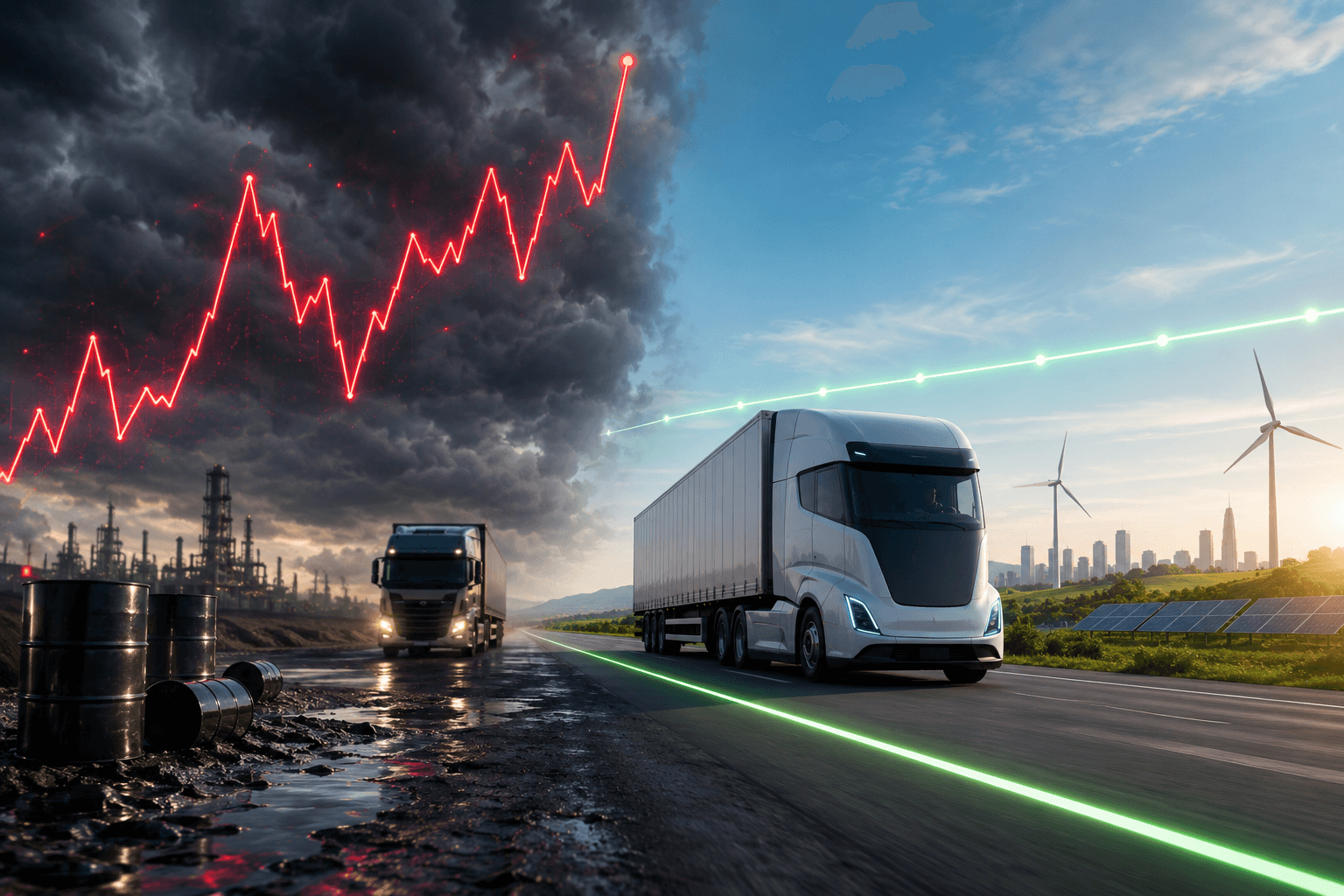
In March 2026, inland 500ppm diesel was sitting at around R18.50 per litre. By the May adjustment, it had broken R32 per litre for the first time in South African history — a jump of more than R13 a litre in two months.
We all know why. The interesting question isn't the cause — it's that the price right now isn't really the problem. The problem is that any business running on diesel has, once again, been ambushed by its single biggest variable cost.
The real problem isn't the spike — it's the volatility
If oil settled back down tomorrow, every fleet operator in the country would breathe out — and then go right back to running a business where their single largest variable cost can move 30, 40 or 50% in a quarter without warning.
That's the problem. Not this month's price. The fact that there is no "next month's price" you can plan around.
Maybe the Hormuz situation clears in eight weeks. Maybe it drags on for eight months. Either outcome leaves you running a transport, logistics or delivery business where the next budget cycle is set by a war you have no influence over, an exchange rate you can't hedge cheaply, and a fuel levy that the National Treasury keeps having to apply temporary plasters to (the May 2026 diesel levy relief was R3.93/litre — a useful number when you remember it has to be funded from somewhere).
And it's worth being honest: this volatility isn't new. In March 2016, inland diesel was sitting at R9.58 per litre. Ten years later — even before the Iran shock — it had already nearly doubled to R18.50, and with the current spike it's now more than triple what it was a decade ago.
The path there wasn't a smooth line either:
- Late 2020: R13.89/litre
- Late 2021: R18.75 after the Russia–Ukraine spike
- 2024–2025: drifting around R18–R20
- May 2026: R32+ after the Hormuz disruption
The "normal" diesel price has been a moving target for the better part of a decade.
"But electricity also goes up"
It does. We're not going to pretend Eskom is a saint.
NERSA has already approved Eskom increases of 8.76% for 2026 and 9.19% for 2027.
Those are real increases — but they closely track inflation, and (as the 2027 number being already locked in shows) they're far more predictable. You can see them coming a year in advance and price them into your business.
What's not in the picture:
- No overnight nearly-50% spike because a chokepoint closed 7,000 km away.
- No exposure to the rand–dollar rate.
- No surprise R9/litre move between one Wednesday and the next.
A 9% annual increase you can see coming a year in advance and bake into pricing is a fundamentally different animal to a 50% move you find out about a week before it hits — and then scramble to fill up your diesel tanks with many suppliers out of stock.
One is a cost. The other is a risk.
The EV math, even at "normal" diesel prices
Strip out the war, the levies, the rand. Put diesel back at a calm R20/litre.
An 8-tonne diesel commercial vehicle running real-world consumption costs roughly R5.60–R7.00 per kilometre in energy. The same kilometre in an electric equivalent, charged off the grid at commercial tariffs, costs roughly R1.50–R1.90. Charge it from a solar-backed system on your depot and you're closer to R1 per kilometre.
That's the 70–80% operating energy cost saving that EVs deliver — and that gap exists before you factor in any diesel volatility premium. When diesel is at R32/litre, the saving isn't a nice-to-have. It's the difference between a viable margin and a brutal one.
The opt-out: what diesel can't do
Here's the part most fleet conversations skip.
If you don't like the price of electricity, you can opt out of buying it. You can put a solar system on your depot and start producing your own. Commercial solar in South Africa now generates electricity at a levelised cost of around R1.00–R1.50 per kWh over a 25-year asset life — well under half what Eskom or your municipality is charging on a commercial tariff, and the cost curve for solar PV is still falling.
If the capex isn't appealing, a Power Purchase Agreement (PPA) lets you lock in a fixed rate per kWh for 20 years with no upfront cost. You sign once. You know your energy price until 2046.
You cannot do this with diesel.
- There is no PPA for diesel.
- There is no rooftop installation that makes your own diesel.
- You are, structurally, a price-taker on a globally traded commodity that is repriced every time a missile lands somewhere.
That asymmetry is the actual case for going electric — not just lower running costs, but the ability to take a cost line that is permanently exposed to geopolitics and convert it into one you control on a 20-year horizon.
What this looks like in practice
A modern commercial EV fleet, paired with depot solar (owned or via PPA), gives you three things diesel can't:
- A predictable energy cost you can write into customer contracts.
- A flat-to-declining cost curve as solar gets cheaper and your panels keep producing.
- Zero exposure to oil markets, exchange rates, or fuel levy changes.
When the next Hormuz happens — and there will be a next one — your fleet keeps running on energy you priced in 2026.
Frequently Asked Questions
Why did the diesel price jump so much in May 2026?
The May 2026 spike — pushing inland 500ppm diesel above R32 per litre for the first time — was driven by the Strait of Hormuz disruption and a weaker rand. Around 20% of the world's seaborne oil moves through Hormuz, so any threat to that chokepoint flows directly through to South African pump prices within weeks.
How do I know if electric vehicles will work in my fleet?
Flux Fleet offers an EV fleet analysis where we process your telematics or route data and point out exactly which parts of your fleet electric vehicles could add value to, which vehicles would work best, and what the charging requirement and ideal infrastructure would be. Get in touch to start the analysis.
Can you really lock in electricity costs with a solar PPA?
Yes. A commercial Power Purchase Agreement (PPA) lets you sign a fixed per-kWh rate for up to 20 years with no upfront capex — the developer installs and owns the system, you just buy the electricity. That means your transport energy cost is set today through to 2046, regardless of oil prices, the rand, or fuel levies.
Aren't Eskom tariffs also volatile?
Eskom increases are real but predictable. NERSA has already locked in 8.76% for 2026 and 9.19% for 2027 — visible a year in advance and easy to bake into pricing. That's structurally different from a 30–50% diesel move triggered overnight by a geopolitical event 7,000 km away.
How long has diesel been this volatile in South Africa?
Diesel has more than tripled over the past decade — from R9.58/litre in March 2016 to over R32/litre in May 2026 — with major spikes around COVID, the Russia–Ukraine war, and now the 2026 Hormuz disruption. The "normal" diesel price has been a moving target for the better part of ten years.
Flux Fleet helps South African operators move from diesel exposure to fixed-cost electric fleets. We handle the vehicles, the charging infrastructure, and the solar / PPA structure to lock in your energy costs for the next 20 years.
See what we do → · Browse the electric truck range →
Sources
- Department of Mineral and Petroleum Resources — official fuel price adjustments, May 2026.
- ElyForma — South African monthly inland 500ppm and 50ppm diesel history (2024–2026).
- BusinessTech, Cars.co.za, AutoTrader, The South African — May 2026 fuel price coverage and Iran/Hormuz context.
- PowerOptimal — Eskom tariff increases vs. inflation since 1988 (2026 update); NERSA-approved 2026 (8.76%) and 2027 (9.19%) increases.
- World Bank, Statista, U.S. Congressional Research Service — Strait of Hormuz oil flow share and 2026 disruption analysis.
Frequently asked questions
Why did the diesel price jump so much in May 2026?
The May 2026 spike — pushing inland 500ppm diesel above R32 per litre for the first time — was driven by the Strait of Hormuz disruption and a weaker rand. Around 20% of the world's seaborne oil moves through Hormuz, so any threat to that chokepoint flows directly through to South African pump prices within weeks.
How do I know if electric vehicles will work in my fleet?
Flux Fleet offers an EV fleet analysis where we process your telematics or route data and point out exactly which parts of your fleet electric vehicles could add value to, which vehicles would work best, and what the charging requirement and ideal infrastructure would be. Get in touch at https://fluxfleet.co.za/contact to start the analysis.
Can you really lock in electricity costs with a solar PPA?
Yes. A commercial Power Purchase Agreement (PPA) lets you sign a fixed per-kWh rate for up to 20 years with no upfront capex — the developer installs and owns the system, you just buy the electricity. That means your transport energy cost is set today through to 2046, regardless of oil prices, the rand, or fuel levies.
Aren't Eskom tariffs also volatile?
Eskom increases are real but predictable. NERSA has already locked in 8.76% for 2026 and 9.19% for 2027 — visible a year in advance and easy to bake into pricing. That's structurally different from a 30–50% diesel move triggered overnight by a geopolitical event 7,000 km away.
How long has diesel been this volatile in South Africa?
Diesel has more than tripled over the past decade — from R9.58/litre in March 2016 to over R32/litre in May 2026 — with major spikes around COVID, the Russia–Ukraine war, and now the 2026 Hormuz disruption. The 'normal' diesel price has been a moving target for the better part of ten years.
Ready to electrify your fleet?
Talk to the Flux Fleet team about what switching to electric looks like for your operation.
Get in touch