Electric Trucks in South Africa: What Finally Tipped the Market, and Why the Efficiency Is Real
Electric trucks are no longer a future consideration for South African fleet operators — they are a present commercial decision. Diesel costs have risen sharply, battery prices have collapsed, and the manufacturers who solved mass-production at scale are now pricing accordingly. The question for most fleet and logistics managers is no longer whether to consider electric trucks, but when the numbers start to make sense and in which parts of their fleets could they work.
This guide breaks down how modern electric trucks work differently to diesel, and why those differences translate into a lower total cost of ownership across the life of the vehicle.
Electric Trucks in South Africa: From Pilot to Practical
Electric trucks are not new to South Africa. European manufacturers have been operating electric commercial vehicles locally for a few years, and a number of larger operators have run small pilot fleets as part of broader moves toward greener transport and ESG compliance. The intent was always there. The hesitation was economic.
The central question hanging over every pilot programme was the same: can electric trucks reach cost parity with diesel? And in the majority of cases, the answer used to be no.
That point of cost parity has now been reached — and then some. Through China's highly efficient manufacturing processes and rapid advances in battery technology, electric trucks today offer total cost of ownership savings of up to 50% compared to diesel when fuel, maintenance, and lifecycle costs are properly accounted for.
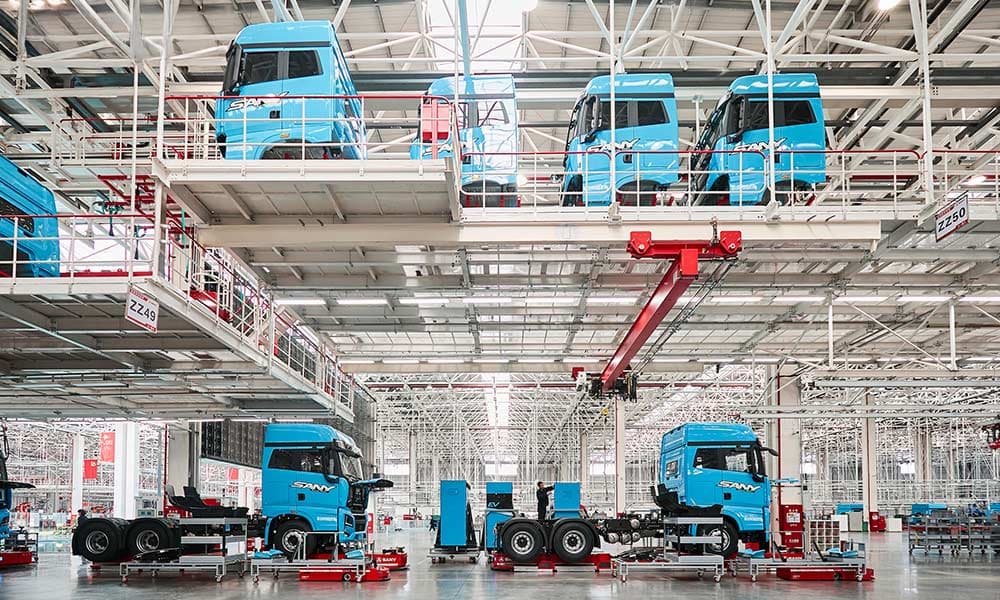
The reason Chinese manufacturers can deliver at these price points comes down to scale — and the numbers are staggering. In 2024, just over 90,000 electric trucks were sold globally, with more than 80% of those sold in China alone. Then in 2025, China sold 231,000 electric heavy trucks — more than double the entire world's output the previous year. Electric trucks now account for around 30% of all new truck sales in China, with industry leaders including SANY projecting 70–80% EV penetration in the Chinese truck market within a few years.
That level of production volume drives down the cost of every battery cell, motor, and drivetrain component through economies of scale that no other market has come close to matching. South African operators are now able to access vehicles built by manufacturers who have already solved the hard problems of electric truck production at mass scale — and are pricing accordingly.
For fleet operators who watched the early European pilots with interest but held back on cost grounds, that calculation has now fundamentally changed.
How Electric Trucks Differ From Diesel — Fundamentally
A diesel truck converts fuel into mechanical energy through combustion. That process is inherently inefficient: roughly 30–40% of the energy in the fuel actually reaches the wheels, with the rest lost as heat.
An electric truck uses a battery to power one or more electric motors. Electric drivetrains are 85–95% efficient — almost all the energy drawn from the battery reaches the wheels. That gap in efficiency is the foundation of the electric truck's economic case.
But efficiency is just the starting point.
Energy Efficiency: More Kilometres per Rand
Electric trucks can be charged during off-peak hours when grid electricity is cheapest — and increasingly, fleets are pairing chargers with on-site solar to reduce grid dependence further.
When you convert the per-kilometre energy cost:
- Diesel: At current South African pump prices, a typical 12-tonne truck costs roughly R6.00–R7.00 per km in fuel alone.
- Electric: An equivalent electric truck, charged at average commercial rates, typically costs R1.60–R1.80 per km in electricity.
Over a 300 km daily route, that difference compounds quickly.
Regenerative Braking: Recovering Energy You'd Otherwise Lose
In a conventional truck, every time the driver applies the brakes, kinetic energy is converted to heat and lost entirely. In an electric truck, that same braking energy is captured and fed back into the battery.
On urban routes with frequent stops — loading bays, intersections, traffic — regenerative braking can recover a meaningful percentage of the energy used, extending range without any additional energy input.
For South African fleet operations running urban distribution routes, regenerative braking is not a gimmick. It's a real contributor to daily efficiency.
Maintenance: Fewer Parts, Lower Costs, Less Downtime
A diesel engine has hundreds of moving parts: pistons, crankshafts, timing belts, fuel injectors, turbochargers, exhaust systems, and DPF filters. Each is a potential failure point, and each requires scheduled servicing.
An electric drivetrain has a fraction of the moving parts — and critically, eliminates entire categories of service items that diesel operators know well.
In practice this means:
- No engine oil changes — the single most frequent diesel service item, eliminated entirely
- Simpler transmission — SANY electric trucks use fewer gear ratios than equivalent diesel models, meaning less complexity, fewer service points, and lower transmission maintenance costs over the vehicle's life
- Brake pads last twice as long — regenerative braking handles the majority of deceleration, with friction brakes used only for final stopping. In real-world operation this typically doubles brake pad life before replacement is needed
- No DPF cleans — a common and costly diesel headache that simply doesn't exist on an electric truck
- No exhaust system servicing — no catalytic converters, no EGR valves, no SCR systems, and no AdBlue to manage
Servicing intervals are longer, and when service is required, the scope and cost are both lower.
Performance: Instant Torque, Consistent Power
Electric motors deliver maximum torque from zero RPM. In practice, an electric truck pulls away from a standing start with more force than an equivalent diesel — a meaningful advantage when loaded, moving through a depot, or climbing an incline.
Diesel engines produce peak torque only within a specific RPM band. Electric motors have no such limitation. The result is a truck that feels more responsive under load, handles variable payloads more consistently, and puts less stress on the drivetrain over its operating life.
For drivers, it means a quieter, smoother cab with less vibration. For operators, it means a more predictable driving profile and fewer drivetrain-related complaints.
The Lifecycle Advantage: Why Electric Trucks Age Differently
This is the point most fleet comparisons understate. With diesel trucks, maintenance costs tend to increase as the vehicle ages. Wear on pistons, injectors, turbochargers, and gearboxes means a truck at 500,000 km is materially more expensive to run than one at 100,000 km.
Electric trucks don't follow this curve. The drivetrain has far fewer wear components. Battery degradation is gradual and predictable — modern lithium iron phosphate (LFP) batteries are designed for commercial cycling and retain the majority of their capacity well past 4,000 charge cycles.
For fleet planning, this means the cost per kilometre of an electric truck stays far more consistent across its operating life. You don't face the steep maintenance cost escalation that typically forces diesel replacement at 5–7 years. An electric truck, operated and charged correctly, can remain cost-effective well beyond that horizon — and it is usually in the interest of fleet operators to keep their electric trucks for much longer, typically 10–12 years.
The SANY Electric Truck in South Africa
The SANY Electric Truck is one of the most capable purpose-built electric commercial vehicles available in South Africa today. SANY is the world's second largest electric heavy truck manufacturer — built on the production scale and real-world deployment that only China's EV truck boom has made possible. That scale of manufacturing and real-world deployment is reflected directly in the quality, reliability, and pricing of the vehicles South African operators can now access.
Designed for heavy-duty application, the SANY Electric Truck delivers the efficiency and performance advantages described above to routes and loads that were previously considered the exclusive domain of diesel.
- High-capacity battery system suited to full-day commercial routes
- Regenerative braking integrated into the drive system
- Robust build quality suited to South African road and load conditions
- Full after-sales support through Flux Fleet in South Africa
Flux Fleet supplies and supports the SANY Electric Truck for South African operators. View the SANY Electric Truck range →
Is an Electric Truck Right for Your Operation?
Electric trucks perform best where:
- Daily routes are predictable — knowing return distance allows accurate charge planning
- Depot-based charging is available — this makes for the simplest charging infrastructure implementation
- Shuttle routes — short- or medium-distance circuits run continuously to the same point, allowing for fast top-up charging or battery swapping
- Good utilisation — the more the electric truck's tyres are on the road, the better, allowing fuel and maintenance savings to compound and offset the vehicle's purchase price
They are currently less suited to long-haul routes exceeding 400–500 km per day without intermediate charging — though battery swapping capabilities do enable some opportunities for high-frequency routes where swapping stations can be placed along the route.
Frequently Asked Questions
How much do electric trucks cost compared to diesel in South Africa?
The upfront purchase price is currently higher than an equivalent diesel. However, when total cost of ownership is calculated — including fuel, servicing, and downtime — electric trucks can deliver savings of up to 50% over the vehicle's lifetime, typically reaching payback within 2 years.
Can electric trucks handle South African road conditions?
Yes. Commercial electric trucks like the SANY are engineered for heavy loads and varied surfaces. They are built for and tested in harsh conditions, and all currently available tractor models are off-road capable.
What happens to charging during load shedding?
Fleets manage this by scheduling charging during available grid windows, or supplementing with solar and battery backup at the depot. With predictable daily routes, overnight charging can be planned around load shedding schedules. Flux Fleet assists with charge planning and scheduling through software.
How long do electric truck batteries last?
Commercial LFP batteries in electric trucks are rated for over 4,000 charge cycles while retaining more than 80% of their original capacity. For a truck doing one full charge per day, this translates to well over 10 years of operational life before meaningful capacity loss.
Ready to see which SANY electric trucks suit your fleet? Browse the full range — specs, battery sizes, and energy costs for every model — on our electric trucks page.
Flux Fleet supplies electric commercial vehicles across South Africa. View our electric truck range or contact us to discuss your fleet.
Frequently asked questions
How much do electric trucks cost compared to diesel in South Africa?
The upfront purchase price is currently higher than an equivalent diesel. However, when total cost of ownership is calculated — including fuel, servicing, and downtime — electric trucks can deliver savings of up to 50% over the vehicle's lifetime, typically reaching payback within 2 years.
Can electric trucks handle South African road conditions?
Yes. Commercial electric trucks like the SANY are engineered for heavy loads and varied surfaces. They are built for and tested in harsh conditions, and all currently available tractor models are off-road capable.
What happens to charging during load shedding?
Fleets manage this by scheduling charging during available grid windows, or supplementing with solar and battery backup at the depot. With predictable daily routes, overnight charging can be planned around load shedding schedules. Flux Fleet assists with charge planning and scheduling through software.
How long do electric truck batteries last?
Commercial LFP batteries in electric trucks are rated for over 4,000 charge cycles while retaining more than 80% of their original capacity. For a truck doing one full charge per day, this translates to well over 10 years of operational life before meaningful capacity loss.
Ready to electrify your fleet?
Talk to the Flux Fleet team about what switching to electric looks like for your operation.
Get in touch