Electric Fleet Vehicles in South Africa: The 2025 Business Case for Operators
For years, the conversation around electric fleet vehicles in South Africa hit the same wall: the upfront cost of a commercial EV was significantly higher than its diesel equivalent, and the kilometres travelled by most fleets did not generate enough fuel and maintenance savings to recoup the premium within a sensible payback window. The maths simply did not work for most operators, and the decision to stay with diesel was a rational one.
That has now changed. Electric vehicle and battery technology has improved year after year, and we are now past the point where commercial EVs reach cost parity with their diesel equivalents. Beyond parity, well-matched electric fleets are delivering substantial total-cost-of-ownership savings — in many cases the biggest structural cost reduction a fleet operator can make this decade.
For commercial fleet operators in 2025, the question is no longer whether electric vehicles work in a South African context. It is how to sequence the transition without disrupting operations — and where to start.
The Fuel Cost Gap Is Now Hard to Ignore
Diesel prices in South Africa have risen by more than 60% over the past five years, with wholesale diesel sitting around R18 per litre at the start of 2025 and pump prices well into the R20s. For a fleet running 20 delivery vans covering 150 km per day each, that translates to hundreds of thousands of rands in additional annual operating costs — costs that were not in any budget three years ago.
Electric vehicles charged on off-peak grid electricity or on-site solar cost a fraction of that per kilometre. TCO models we run with clients consistently show electric fleets operating at R0.40–R0.70 per kilometre in energy costs versus R1.80–R2.20 per kilometre for a comparable diesel vehicle at current fuel prices.
That gap is not a rounding error. It is the single biggest driver of fleet electrification decisions we are seeing in 2025.
Maintenance Is the Second Lever
An electric drivetrain has roughly 20 moving parts. A diesel drivetrain has more than 200. The removal of oil changes, transmission services, fuel filters, exhaust system repairs, and the reduction in brake wear (thanks to regenerative braking) adds up to 40–60% lower maintenance costs over a vehicle's life.
To put a number on it: a typical 3.5-tonne diesel delivery van costs R30,000–R50,000 per year in scheduled servicing and consumables alone, before unplanned repairs. A comparable electric van's annual service cost typically falls below R15,000, with longer intervals between visits.
For a fleet manager already dealing with technician shortages and rising workshop rates, this is not a minor benefit. It is a structural shift in how much labour your fleet consumes over time — and a cost line that becomes more predictable, not less.
A Worked Example: Diesel vs Electric for a 20-Vehicle Last-Mile Fleet
To make this concrete, here is an actual TCO comparison from a recent Flux Fleet model. The fleet is 20 vehicles, each running 200 km per day, seven days a week, over a six-year lifetime — a realistic profile for a last-mile delivery operation in Gauteng or the Western Cape.
The diesel benchmark is an Isuzu D-Max Gen 6 250c single cab. The electric alternative is a DFSK EC35 Electric Panel Van. Both vehicles are paid for in cash for the purposes of this comparison.
Per-kilometre running costs:
The diesel vehicle consumes 10 L/100km. At a diesel price of R20.00 per litre, that is R2.00/km in fuel, plus R0.60/km in maintenance — a total of R2.60/km in running costs.
The electric vehicle consumes 18.6 kWh/100km. At a depot electricity cost of R2.00/kWh (excl.), that is R0.37/km in energy, plus R0.26/km in maintenance — a total of R0.63/km in running costs.
That is a R1.97/km saving on running costs alone.
Monthly cash flow:
Across the 20-vehicle fleet, the diesel running cost is R315,460 per month. The electric running cost is R76,676 per month. The fleet saves R238,784 every single month in running costs once electrified.
Capital and payback:
The DFSK EC35 carries a purchase premium of roughly R50,000 over the Isuzu D-Max — a Capex gap of just over R1,000,000 across 20 vehicles. With monthly savings of R238,784, that gap pays back in 0.4 years — approximately five months.
Six-year total cost of ownership:
Over the full six-year lifetime, including residual value (40% for diesel, 25% for electric in this conservative model), the diesel fleet costs R1,363,680 per vehicle to own and operate. The electric fleet costs R598,884 per vehicle. Across 20 vehicles, the fleet saves R15,295,926 in total — a 56% reduction in total cost of ownership.
The internal rate of return on the additional capital spent on the electric vehicles, in this scenario, is several thousand percent annualised. There are very few capital deployment opportunities in any business that compete with that.
The chart below summarises the headline numbers.
A few important caveats. These numbers are specific to this fleet profile, this vehicle pairing, and this energy pricing assumption. A fleet covering only 80 km per day rather than 200 will see a longer payback. A fleet using grid power at a higher tariff, without solar offset, will save less per kilometre. The point is not that every fleet sees these exact numbers — it is that for fleets that match this kind of profile, the maths is now overwhelmingly in favour of electrification, and a proper TCO model on your own data will tell you which side of the line you sit on.
Load Shedding: A Solved Problem, Not a Dealbreaker
The load shedding objection deserves a direct response. Yes, charging infrastructure must be designed with energy availability in mind. No, this does not make fleet electrification impractical.
The solution is straightforward: solar generation combined with battery storage at the depot, sized to charge the fleet during the day or to buffer overnight charging. A properly designed system charges vehicles regardless of whether Eskom is cooperative. The capital cost of solar and storage is offset by lower electricity tariffs and, increasingly, by the value of grid independence itself.
The key word is "designed." Ad hoc charging without an energy assessment is risky. A proper depot energy study — looking at your tariff structure, grid connection capacity, and fleet charging window — turns load shedding from a blocker into a non-issue.
Commercial EV Availability in South Africa Has Changed
Two years ago, a fleet manager looking for a South African-compliant electric light commercial vehicle with a meaningful payload had very few options. That has changed.
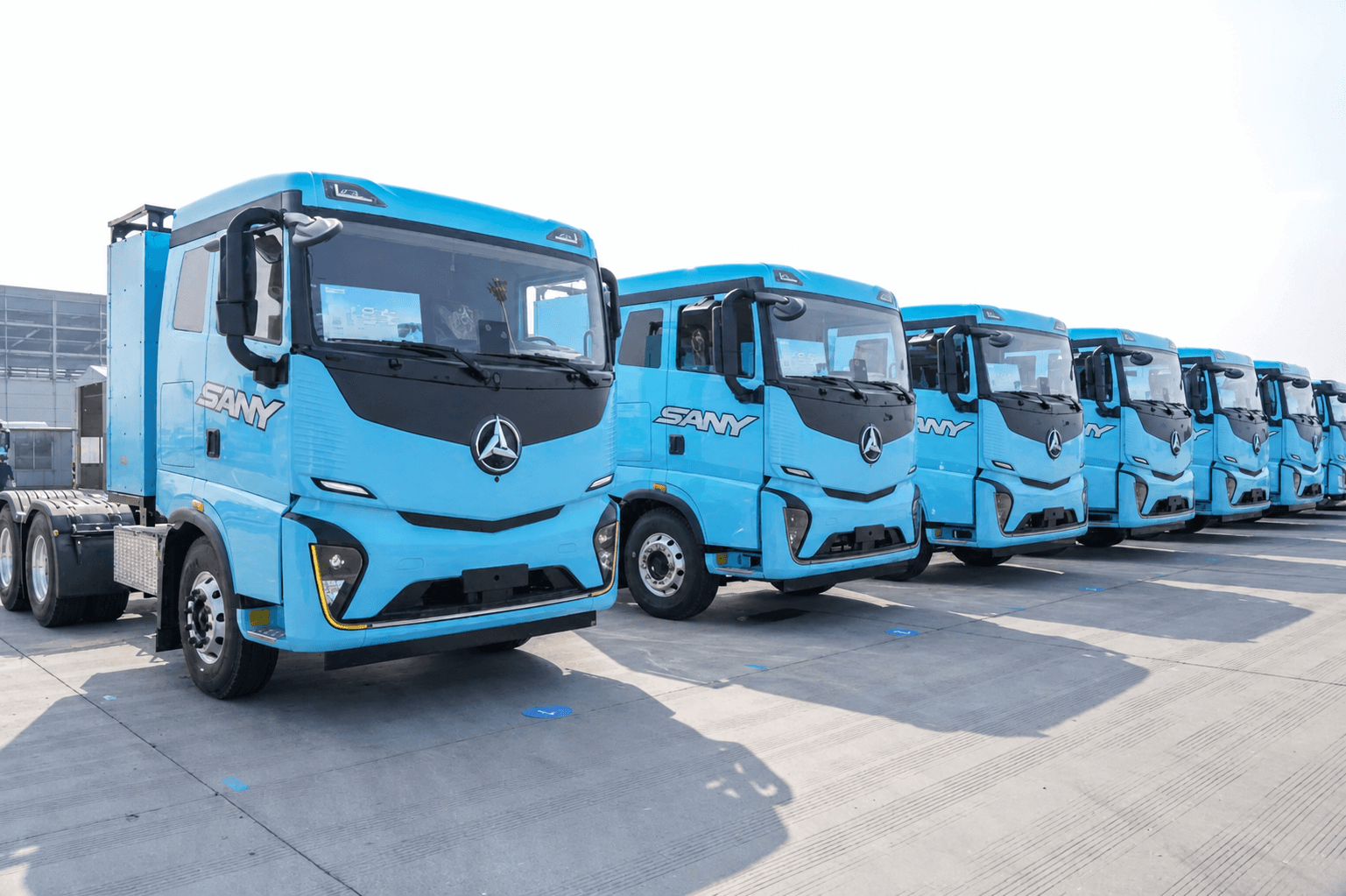
SANY in particular has entered the South African market in a serious way. SANY is the world's number-one electric truck brand by sales globally, and in 2026 they are set to introduce — for the first time in South Africa — a full range of electric trucks all the way up to heavy-duty truck tractor models with a technically permissible Gross Combination Mass of up to 120 tonnes. Fully electric, at that scale. That is a genuine game changer for the local freight and mining sectors, not an incremental update.
Alongside SANY, manufacturers including Foton and JAC are bringing electric vans and medium trucks to the South African market, with offerings spanning:
- Payloads from 800 kg to 5 tonnes for light and medium commercial use
- Ranges of 150–250 km on a charge — sufficient for the vast majority of last-mile and regional delivery routes
- Heavy-duty electric truck tractors arriving for mining and freight applications
- Local distributor networks and service partnerships being established
The technology risk that existed in 2022 is materially reduced for vehicles in the light-to-medium commercial category, and is closing rapidly at the heavy-duty end. Fleet operators should still scrutinise warranty terms, parts availability, and aftersales support carefully when selecting a supplier — this is one of the areas where a feasibility study pays for itself.
The Carbon Tax Lever Is Real
Beyond fuel and maintenance, South Africa's carbon tax is moving from a marginal cost into a meaningful one. Phase 2 of the carbon tax regime, scheduled to begin in 2026, will sharply reduce the tax-free allowances that have shielded most fleet operators to date. Combined with rising carbon tax rates per tonne of CO₂, this turns diesel fleet emissions from a footnote into a budget line item.
For fleets supplying retailers, manufacturers, or logistics partners with their own Scope 3 emissions targets, the pressure is already arriving in tender requirements and contract renewals. Electrification is increasingly a procurement issue, not just a cost issue.
Where Fleets Should Start
The biggest mistake operators make is thinking they have to electrify everything at once or not at all. The right approach is sequential:
-
Identify your best candidates first. Vehicles with predictable daily routes returning to a fixed depot are the easiest wins. These are typically last-mile delivery vans, utility vehicles, and depot, mine, or plantation shuttles.
-
Model the TCO with your real data. Generic industry figures are useful for orientation. Your actual fuel consumption, maintenance history, and route profiles will produce a much sharper picture of payback period and savings.
-
Design the charging infrastructure before buying the vehicles. Grid capacity, tariff structure, and solar viability all affect whether your depot can support the fleet you plan to run.
-
Run a proof of concept. Deploy one or two vehicles on your highest-density routes, gather data for 1–2 weeks, and let the numbers validate the business case before committing to a full rollout.
This is exactly the process Flux Fleet takes clients through — from feasibility analysis using existing telematics data, to proof of concept, to full implementation.
Frequently Asked Questions
How much does it cost to convert a fleet to electric vehicles in South Africa? Capital costs vary substantially by vehicle class and charging infrastructure requirements. For a typical 10-vehicle light commercial fleet, expect a vehicle premium over diesel equivalents, offset by 1–3 year payback periods through lower running costs.
What is the range of commercial electric vehicles available in South Africa? Light commercial electric vans typically offer 150–250 km of real-world range under load. Medium-duty electric trucks offer 200–400 km. Heavy-duty electric truck tractors entering the market offer 200–300 km between charges, with battery-swap options now introduced by SANY effectively eliminating charging downtime and enabling entirely new use cases for electric trucks in long-distance and shift-based operations.
How does load shedding affect electric fleet operations? Properly designed depot infrastructure — combining solar generation, battery storage, and scheduled charging — eliminates load shedding as an operational risk. Fleets that rely solely on grid power without a properly designed charging schedule are exposed; fleets with thought-through charging plans, electricity backup, and built-in contingency for outages are not.
Are there incentives for commercial EV adoption in South Africa? Direct purchase incentives for commercial EVs remain limited compared to European or Asian markets. The primary financial drivers are operational savings (fuel and maintenance), Section 12B accelerated depreciation on solar generation assets, and the avoided cost of carbon tax exposure as Phase 2 takes effect.
What is the resale value of electric commercial vehicles in South Africa? The local secondary market for commercial EVs is still developing, but industry expectations are positive. Because electric vehicle maintenance costs stay low throughout the vehicle's life — unlike internal combustion vehicles, where maintenance costs and refurbishment requirements rise sharply once high mileage is reached — electric commercial vehicles are expected to remain useful and cost-effective for far longer. That extended useful life supports stronger residual values than many operators are currently pricing into their TCO models.
The Window Is Narrowing
Early adopters are locking in supplier relationships, charging infrastructure, and fleet management processes. They are also building the operational knowledge — driver behaviour, charging schedules, energy management — that will be a competitive advantage as diesel prices continue to rise and remain dependent on imported oil and an unstable geopolitical environment, carbon tax exposure increases, and emissions requirements work their way into customer contracts.
The question for fleet operators heading into 2026 is not whether to electrify. It is when, and how to do it without disrupting operations in the process.
If you want to understand what electrification looks like for your specific fleet, get in touch with the Flux Fleet team. We will run the numbers with you.
Ready to electrify your fleet?
Talk to the Flux Fleet team about what switching to electric looks like for your operation.
Get in touch